""-anchor
shopify-section-template--24592089350463__rich_text_MXJFbj-anchor

Pride in the Piedmont

Winston-Salem is at a crossroads, really. Let’s remember a time when travel was via oxen cart, horseback, or on foot. A map was an important tool, and the one drawn by Joshua Fry and Peter Jefferson, Thomas Jefferson’s father, documenting the Great Wagon Road was one of the first based upon first-person surveys.

Salem, founded in 1766, was along the way to the southern terminus of the Great Wagon Road. Travel in the 1700s was arduous, but you could say that this Road was a super highway of its time. It connected Philadelphia and the Moravian settlements of Bethlehem and Nazareth in Pennsylvania to the southern outpost in Salem. People were flowing south and goods from North Carolina were headed north.

Textiles became a vital part of the economy in Salem in the late 1700s and early 1800s. The Single Sisters Choir had a successful business weaving linen and sewing leather gloves, which were needed for everyday life in Salem and the excess could be sold to other settlers. Soon, bigger mills and automated weaving looms found a home in Salem processing both wool and cotton.

In the late 1800s, tobacco warehouses and processing plants began cropping up. It was a central place for farmers to bring their crops for sale and manufacturing. These warehouses and plants grew into an empire and set Winston-Salem, as the town became known in 1913, up as a center for manufacturing and finance.

As time passes, many things change. Tobacco fell out of favor and much of the textile business has moved away, but that hasn’t squelched Winston-Salem’s will to survive and excel. With the same industriousness of the turn of the 20th century, Winston-Salem is fueling its drive toward the future with a past rooted in the arts and a determination to find a better way to do things. When innovation and arts come together, they create a synergy that is exhilarating and a city that is vibrant, alive, and welcoming.

The Mast Store in Winston-Salem is in a building that was once the largest retailer in town. Today, we hope you’ll find an experience that hearkens back to “the best place to get it.”

shopify-section-template--24592089350463__fifty_fifty_image_text_EUnFfF-anchor

Parking

Parking for the store is available at the 6th/Cherry-Trade Parking Deck. The 6th/Cherry-Trade Parking Deck is located at 525 Cherry St N, Winston-Salem, North Carolina. Park on the second level and walk directly into the store. Parking on the street is free after 6 p.m. during the week and on weekends.

For motor coaches, vans, and other groups please call us for specific instructions at 336-727-2015

shopify-section-template--24592089350463__small_image_grid_MEgKyT-anchor

Plan Your Visit

Winston-Salem is a city filled with heritage attractions just waiting to help you discover our shared past. It is also a city re-inventing itself. Part of its fuel is its creativity. You’ll see it in the Downtown Arts District along with the Innovation Corridor and in its contribution to medical care. While you’re here, there are lots of things you won’t want to miss – a visit to the Old Salem Museums and Gardens, a baseball game under the lights, the First Friday Gallery Hop, or enjoy a Krispy Kreme Original Glazed Doughnut where this tasty treat got its start (be sure to watch for the Hot Now sign!).

Old Salem

Visit Winston-Salem

Kaleideum
shopify-section-template--24592089350463__multicolumn_K3PKhR-anchor

Area Events

JUNE 19 - 21, 2026

Sidewalk Sale

Winston-Salem Mast General Store

LEARN MORE

Weekly on Saturday

Cobblestone Farmers Market

1007 Marshall Street • 8:30 AM - 12:00 PM

LEARN MORE

shopify-section-template--24592089350463__multicolumn_gzUHU9-anchor

Local Flavor

shopify-section-template--24592089350463__rich_text_H6NyHF-anchor

The Story Behind the Store

The history of the building at 516 North Trade Street actually begins in 1880 when Thomas Jethro Brown, Mitchell Rogers, and William Carter saw the needs of a growing trade center in Winston. Brown and Carter were involved in the tobacco industry, so Rogers managed the growing business. Brown-Rogers & Co. had its first building at the corner of Fourth and Main Streets.

Their business instincts were right. Hardware was in great need for the burgeoning tobacco industry. In the early 1900s, Brown-Rogers & Co. occupied most of the block between Liberty, Fourth, and Main Streets. A second building was built on North Liberty Street to handle the growing business. It opened in 1905. That building came in handy when a fire destroyed the Main and Fourth location in 1913.

-anchor
Old Winston-Salem Store

Historic photo courtesy of Forsyth County Public Library Photograph Collection.

In 1915, W. N. Dixson joined the company as vice-president and general manager. With the passing of Carter in 1924, Dixson purchased his shares and became the president. The company became known as Brown-Rogers-Dixson. Winston-Salem’s population was growing by leaps and bounds, so a new, larger building was commissioned to be designed by Northup & O’Brien, an architectural firm that designed several prominent buildings in the city. When the B-R-D building opened in March of 1928, it was Winston Salem’s largest business. With 70,000 square feet of space, it was also one of the largest retail/wholesale spaces in the South.

-anchor
Old Winston-Salem Store

Historic photo courtesy of Forsyth County Public Library Photograph Collection.

The original flooring in the fashion and mercantile departments was harvested from the Pisgah Forest by the Carr Lumber Company. George Vanderbilt, of Biltmore Estate fame, sold acreage to the Carr Lumber Company for $12 per acre. He could have made much more per acre, but he insisted that the weak trees be taken first and then the rest of the forest would be selectively harvested and new trees planted to replace those that were taken.

-anchor
Winston-Salem Lunch Counter

Photo courtesy of Ronny Dixson.

B-R-D dominated the retail scene in Winston-Salem through World War II and lived up to its slogan as the best place to get it. Its stock included everything from nuts and bolts to sporting goods, like metal roller skates. They even manufactured their own wooden wagons for children to enjoy when steel wasn’t available during the war. Warehouses throughout the Carolinas were added to service its wholesale customers. With locations in Raleigh, Charlotte, and Columbia, many customers could have their orders the next day.

-anchor
Mast Store Winston-Salem Storefront

The Mast Store in Downtown Winston-Salem circa today.

In the late 1960s and early 1970s, it became evident that B-R-D could better serve its clients through the wholesale side of their business, rather than maintaining both a retail and wholesale presence. The retail side was discontinued in the 1970s. Unlike other stores that become Mast Store locations, B-R-D is still in business with a location on Cloverleaf Drive here in Winston-Salem. It services independent dealers in appliances, bedding, etc. and helps them remain competitive in a “big-box” world. When B-R-D left this building, it went through a series of owners and housed offices and a satellite police department.

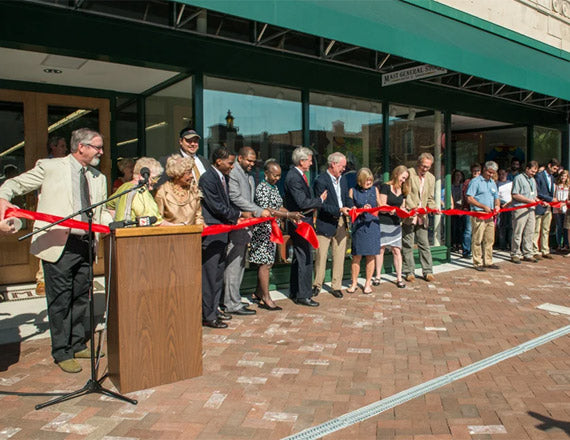
It is now listed as a contributing property for the Arts District Historic District and became a part of the Mast Store Family in May of 2015.

shopify-section-template--24686206124351__small_image_grid_BzQBzG-anchor

Community Partners

In a time when general stores dotted the landscape, business was a mutually beneficial agreement, and it was done with a handshake. That could easily describe our relationship with our Community Partners. The Mast Store supports many groups in its local areas that help meet human needs, champion the arts, promote conservation, and contribute to moving the community forward. These are just a few of the organizations we support locally.

Gateway Nature Preserve

Piedmont Land Conservancy

Second Harvest Food Bank