""-anchor
shopify-section-template--24592089350463__rich_text_MXJFbj-anchor

Resurgence in the Palmetto Capital

Columbia has seen a lot - from the earliest days of the United States to the present day. It's been on the cutting edge and just behind the leaders in a number of instances. Take a look at Columbia's wide thoroughfares. Contrary to what you might think, they are not a recent development but were actually planned for in the 1700s. That's right! Columbia is the nation's second planned city, right behind New Haven, CT, and was established as the state's new capital in 1786. In a vote of 11-7, the name Columbia, the United States' female personage, was chosen over Washington.

The grid for the city was set up with 400 blocks in a two-mile square near the river. The perimeter streets were 150 feet wide and the remaining streets were 100 feet wide. Those are not arbitrary numbers, but were based upon the belief that mosquitos could not travel more than 60 feet without having a little snack.

Columbia is the site of the world's first fully-electrified textile mill. Cotton made the South the natural location for textile mills, and the Columbia Mills Building, which opened in 1894 and now houses the South Carolina State Museum, was fully powered by electricity from day one. That makes the building itself the Museum's largest artifact.

Few of the city's buildings date back before 1865. Much of the city was burned by General Sherman during the Civil War, except, ironically, the First Baptist Church where the State's Order of Secession was drafted and approved.

The building that now houses the Mast Store was constructed in the 1870s during the Reconstruction Era. It's housed many different businesses over the course of time – including an undertaker's parlor, a bar, and two City of Columbia retail destinations – Efird's and Lourie's. Each served the people of the Midlands for over 40 years each.

shopify-section-template--24592089350463__fifty_fifty_image_text_EUnFfF-anchor

Parking

Parking on Main Street is monitored from 9 a.m. until 7 p.m., Monday through Friday. It is $1.50/hour. Look for the Parking Kiosk to pay your parking fee and place the receipt in a visible place on your dash. There are metered spots on cross streets for up to two hours. Parking on Saturdays and Sundays is FREE.

For longer stays, guests may park on the first two levels of the Taylor Street Garage (Entrance address: 1600 Assembly Street, Columbia, SC 29201 - enter through the back door of the store) or the Cannon Garage (Entrance address: 1227 Taylor Street, Columbia, SC 29201) for parking paid by the hour up to 10 hours.

Motorcoaches and RVs are recommended to find metered parking by Finlay Park or along Wayne and Taylor Streets. For more information about parking large vehicles, please call the City of Columbia Parking Department at 803-545-4015.

shopify-section-template--24592089350463__small_image_grid_MEgKyT-anchor

Plan Your Visit

Columbia is famously hot! In a city with roots reaching back to the 1700s, it remains largely undiscovered. Here are a few ideas you won’t want to miss – try some outdoor recreation – the rivers offer great opportunities for paddling, take in a game – the University of South Carolina always has some sort of sporting event, and visit a museum that has as its largest artifact the place where everything else is displayed.

Experience Columbia

The Nickelodeon

Riverbanks Zoo

shopify-section-template--24592089350463__multicolumn_K3PKhR-anchor

Area Events

JUNE 4, 2026

First Thursday on Main

Columbia Mast General Store • 6:00 PM - 7:30 PM

LEARN MORE

June 6, 2026

Land Trust Day

Columbia Mast General Store

LEARN MORE

shopify-section-template--24592089350463__multicolumn_gzUHU9-anchor
shopify-section-template--24592089350463__rich_text_H6NyHF-anchor

The Story Behind the Store

Much of the city of Columbia was burned during the Civil War, including the 1600 block of Main Street. The original building, circa 1870s, was a two-story structure. One of its first occupants was a grocer, G. Diercks. In the mid 1890s, C.H. Baldwin and Sons, previously located at 187 Richardson St., moved in. They also were purveyors of groceries.

In 1915, Efird’s moved into the building. The building was enlarged in the 1910s, including 100 feet to the western side, and a third story. A basement was added in the 1920s. The post-World War I economic explosion and the migration of the population to the city made more space necessary. From 1901 to 1912, Girardeau and Marshall Clothing inhabited the building. Next came a short-lived furniture store, followed by D.B. Miller Co., a meat market. During this time frame, the building housed a saloon, a print shop, a tailor, a shoe and boot store, a boardinghouse on the upper floor, and an undertaker’s parlor.

-anchor
Columbia Hensel Store

Photo courtesy of the South Caroliniana Library, University of South Carolina, Columbia, S.C.

Efird’s, a major rival of the Belk chain, expanded to include 50-60 stores in three states. It carried many items featured in larger stores and offered “one price for all.” In their local advertising, they called themselves “Columbia’s Greatest Department Store.” The store’s 21,000 square feet of space utilized the first floor for silks, dress goods, dry goods, piece goods, shoes, men’s and boys’ clothing, and men’s furnishings. A central staircase led to the second floor, where women’s ready-to-wear clothing, muslin underwear, corsets, and rugs were kept.

Efird’s faced heavy competition from larger national retailers and suburban malls, and the family’s next generation was not interested in taking over the business. In the late 1950s, the Efird brothers decided to sell their store to Belk. For a brief period, a Belk Annex occupied the building.

Lourie’s was founded in St. George, South Carolina by Louis Lourie, one of many Eastern European Jews emigrating to the United States seeking religious freedom in the late 1800s and early 1900s. Lourie’s was known for quality merchandise at a fair price, and keen attention to detail, stressing service and courtesy. Solomon, the eldest son, and A.M. “Mick”, brought the store to Columbia in 1948. Business grew quickly and they expanded in 1950, rapidly outgrowing the new location. In 1960, they began utilizing 42,000 square feet in the store at the corner of Taylor and Main Streets.

-anchor
Mast Store Columbia Storefront

The Mast Store in Downtown Columbia circa today.

The principles on which Lourie’s was established continued to be good business practice: quality merchandise, good fashion sense, and outstanding customer service. In a time before credit cards were available, the store extended credit to its customers, experiencing great customer loyalty, even through difficult economic times.

In the 1960s and 70s, many stores left Downtown Columbia for suburban malls. The Louries, demonstrating a strong commitment to their community, remained, hoping to maintain the downtown area as a viable retail destination. The store closed its doors in 2008, after 48 years in this location.

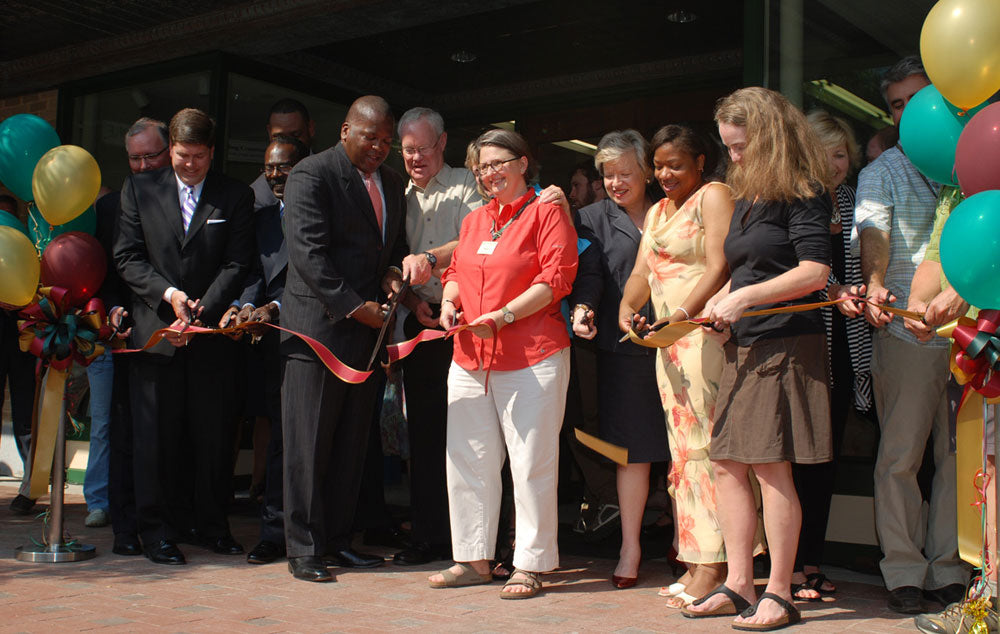
The Mast Store in Columbia opened in 2011.

shopify-section-template--24686095827263__small_image_grid_BzQBzG-anchor

Community Partners

In a time when general stores dotted the landscape, business was a mutually beneficial agreement, and it was done with a handshake. That could easily describe our relationship with our Community Partners. The Mast Store supports many groups in its local areas that help meet human needs, champion the arts, promote conservation, and contribute to moving the community forward. These are just a few of the organizations we support locally.

Congaree Land Trust

Harvest Hope

Palmetto Conservation

Transitions